Painting Above the Stairs: How to Get It Right When Space Is Tight
Painting above stairs in Nottinghamshire done safely and beautifully. JPL Paint Services covers Newark, Balderton, Farndon, Collingham and the surrounding villages.

The bit everyone puts off
The hall, stairs and landing is usually the last part of a home to get attention, and the space above the staircase is the part people put off the longest. It is easy to see why. The ceiling is high, the angles are awkward, and getting a ladder up there safely is not as simple as dragging one out of the garage and leaning it against the wall. So the scuffed paintwork sits there for another year, and another one after that.
We hear this all the time from homeowners across Newark-on-Trent, Balderton, Farndon, Collingham and the surrounding villages. The rest of the house looks smart, but the stairwell gives the game away. If that sounds familiar, this article explains exactly how we approach the job, what preparation actually involves, and what you can expect while we are in your home.
Why painting above stairs is different from any other room
A standard room is straightforward to set up. You move the furniture, sheet the floor, put your ladder at a sensible height and work your way around. Above a staircase, none of that applies.
The floor level changes with every step. The ceiling slopes or rises to a full storey and a half. You are often working over a drop with no flat surface to stand on. Getting this wrong is not just a quality issue, it is a safety issue.
We use a combination of specialist staircase ladders, ladder standoffs, and where necessary a small scaffold tower or platform system to reach the highest points safely. The setup takes longer than a standard room, and that is time well spent. Rushing the access is how accidents happen and how paint ends up on your carpet.
The other thing that catches people out is the sheer surface area. A stairwell ceiling often runs the full height of the house. Factor in the walls on both sides, the spindles, the handrail, the newel posts, the skirting on the stairs themselves, and you are looking at a significant amount of work even in a modest semi-detached.
What preparation looks like in a stairwell
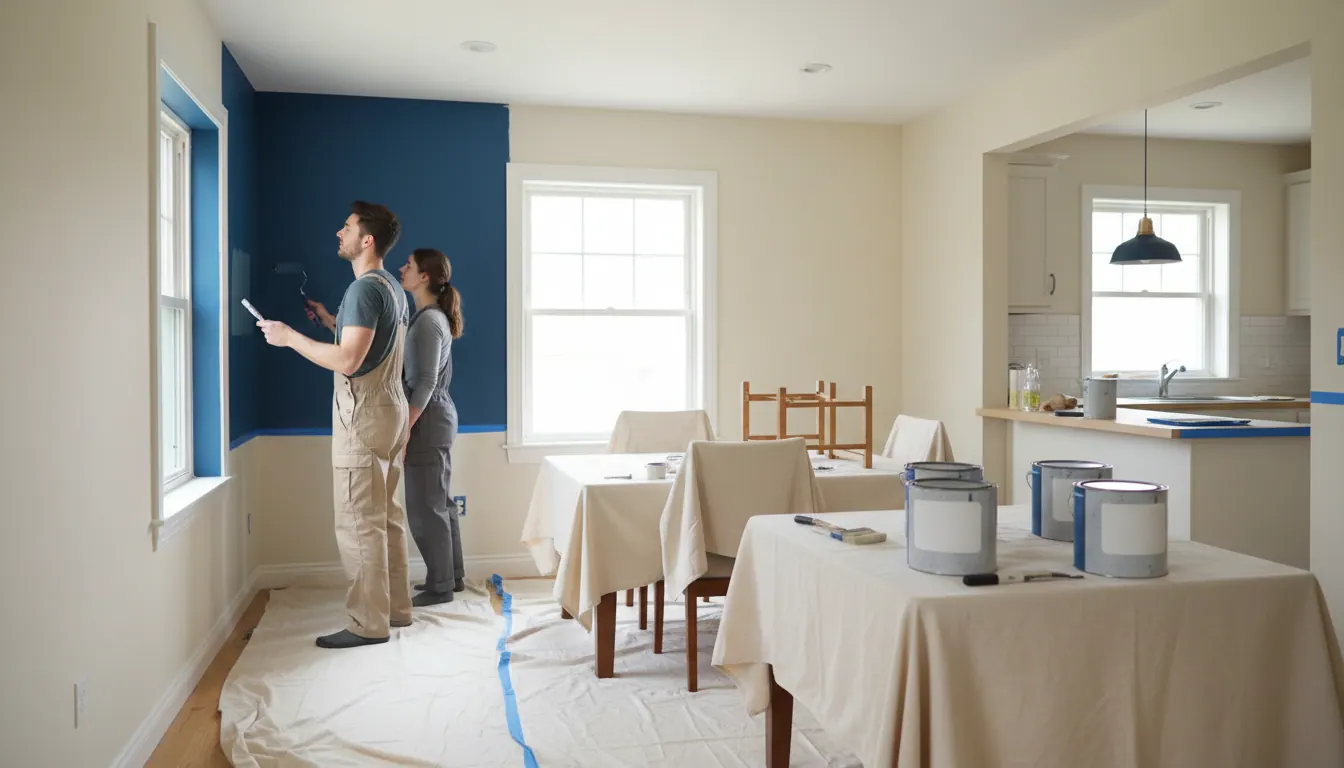
Good preparation is where a professional finish starts. We always begin by sheeting everything down. Stairs are especially important because paint drips travel further when you are working at height.
Then we look at the surfaces themselves:
- Walls and ceilings. Hairline cracks are filled, sanded back and primed before any topcoat goes on. Older properties in Newark and the surrounding villages often have Artex or textured ceilings in the stairwell, and we can work with that rather than against it.
- Woodwork. Banisters, handrails, newel posts and skirting boards are assessed for condition. If the existing finish is varnished wood, sanding is usually needed before painting. A light key with fine-grit paper, a coat of primer or a specialist bonding product, and the new paint will hold properly. Skipping that step is the reason painted woodwork peels within a year.
- Previously painted surfaces. We check for flaking, chalky patches or areas where old paint has gone powdery. These need to be taken back before new paint is applied, otherwise the new coat will only be as good as what is underneath it.
One question we are often asked is whether you can paint over varnished wood without sanding. The honest answer is that you can, but it rarely ends well. The paint sits on top of the varnish rather than bonding to it, and it will lift in time. A proper key takes an extra hour or two but it is the difference between a finish that lasts and one that lets you down.
The finish itself
Once the prep is done, the actual painting is the satisfying part. For stairwell ceilings and walls we typically use a good quality trade emulsion, applied by roller where the surface allows and cut in carefully by brush at every edge and angle. The stairwell has more edges and angles than almost any other space in the house, so the cutting in takes time. That is not a complaint, it is just the reality of the job.
For woodwork, handrails and newel posts, we use a hard-wearing satin or gloss finish depending on what the customer wants. A handrail takes a lot of contact every single day, so the finish needs to be durable. We do not rush coats. Each one needs to be properly dry before the next goes on, and in a stairwell where ventilation can be limited, that matters.
What one of our customers said
Vickie Birnage in Newark had been putting the stairwell off for a while, then had a deadline:
Desperately needed above the stairs being done as am having friends and family around for Christmas! Jon was amazing, he was very punctual, efficient and cleaned up after himself too Did and amazing job, really, really pleased with it. He's competitively priced so would highly recommend him
That job captures something we hear often. The stairwell is the first thing guests see when they walk through the front door. It sets the tone for the whole house. Getting it done before Christmas, a family event or a house sale makes a real difference, and it is the kind of deadline we take seriously.
How long does a hall, stairs and landing take?
This depends on the size of the property, the condition of the surfaces and how much woodwork is involved. A typical three-bedroom semi in Balderton or Fernwood with walls, ceiling and woodwork all being done might take two to three days. A larger detached property with a full-height stairwell, spindles throughout and multiple coats needed on the woodwork could take four or five days.
We will always give you a clear idea of the timeframe before we start. Living around a stairwell being decorated is disruptive because it is the main route through the house. We plan the work to keep that disruption as short as possible, and we will always make sure you can get up and down safely while we are working.
Combining the stairwell with other work
The stairwell often connects to the hallway below and the landing above, and it makes sense to treat all three as one job. A freshly painted stairwell with tired hallway walls either side of it looks unfinished. We regularly take on the full hall, stairs and landing as a single project for homeowners in Winthorpe, Coddington, Elston, Averham and Kelham who want a consistent result throughout.
If you are also thinking about the exterior of your home, our article on exterior painting in Newark covering front doors, window frames and soffits covers what is involved there. And if you are not sure whether your project needs a painter, a decorator or both, this article explains the practical difference and helps you ask the right questions before you book anyone.
Frequently asked questions
How long should a hall, stairs and landing take to paint?
For most three-bedroom homes in and around Newark-on-Trent, allow two to three days for a full repaint of the hall, stairs and landing including walls, ceiling and woodwork. Larger properties, heavily textured surfaces or extensive woodwork with spindles will take longer. We give a clear timeframe before we start so you can plan around it.
Can you paint over varnished wood without sanding it?
You can, but we would not recommend it. Paint applied directly over varnish does not bond properly and will start to lift or peel, often within a year. The right approach is to sand the surface lightly to create a key, apply a suitable primer or bonding coat, then paint. It adds a little time but the finish lasts properly.
What is involved in painting a stairwell ceiling?
The main challenge is safe access. A stairwell ceiling sits at a height that changes as the stairs descend, so standard ladders do not work safely. We use specialist staircase ladder systems and platforms to reach every part of the ceiling without risk. The ceiling itself is prepared, filled if needed, and painted in the same way as any other ceiling, though the angles and the height mean it takes longer than a flat room ceiling.
Do you cover the surrounding villages as well as Newark itself?
Yes. We cover Newark-on-Trent and the surrounding villages including Balderton, Farndon, Coddington, Fernwood, Winthorpe, Collingham, Hawton, Elston, Averham and Kelham. If you are nearby and not sure whether we cover your area, just get in touch and ask.
Ready to get your stairwell sorted?
If the space above your stairs has been on the to-do list for a while, or you have a deadline coming up and want it done properly, we would be glad to take a look and give you a straightforward quote. We work across Newark-on-Trent, Nottinghamshire and the surrounding villages, we turn up when we say we will, and we leave your home clean and tidy when we go.
Call us on 07845 176906 and we can arrange a time to come and have a look.