Painting Skirting Boards and Woodwork in Coddington: Why Preparation Beats Speed
Thinking about skirting board painting in Coddington or Newark? Here's what good preparation and a proper gloss finish actually involves, from JPL Paint Services.

Why Skirting Boards Are Worth Doing Properly
Skirting boards are easy to overlook. They sit at floor level, they collect scuffs and shoe marks, and most people only really notice them when the paint starts to chip or yellow. But when they are freshly glossed and neatly cut in, they pull an entire room together. Done badly, they make a tidy room look unfinished.
I do a fair amount of woodwork glossing across Newark-on-Trent and the surrounding villages, including Coddington, Balderton, Farndon and Fernwood. Skirting boards come up regularly, either as part of a full room repaint or as a standalone job to freshen up a room that is otherwise in decent shape. Either way, the approach is the same: preparation first, finish second.
What "Preparation" Actually Means for Skirting Board Painting
This is where most DIY attempts go wrong, and it is the thing I spend the most time on before a brush goes near the paint tin.
Older properties in Coddington and the Newark area often have skirting boards that have been painted many times over. The paint builds up, the edges become ragged, and any new coat applied over the top just looks lumpy and uneven within a few months. Before anything else, I assess what is there.
Here is what preparation typically involves:
- Sanding back any flaking, peeling or rough areas until the surface is stable and smooth
- Filling dents, holes and gaps where the skirting has pulled slightly away from the wall or floor
- Caulking the top edge where the skirting meets the plaster, because that gap is where paint cracks first
- Cleaning the surface of grease, dust and any old wax or polish that would stop the paint from bonding
- Priming bare wood or heavily sanded areas so the topcoat has something to grip
None of this is glamorous. It takes time. But it is what separates a finish that lasts two or three years from one that starts peeling before Christmas.
Choosing the Right Paint for Skirting Boards
The traditional choice is oil-based gloss, and it still gives a beautiful, hard-wearing finish. It takes longer to dry between coats and has a stronger smell while it is wet, so rooms need ventilating. But the depth of sheen is hard to beat on older wooden skirting boards.
Water-based satin and eggshell finishes have come a long way. They dry faster, the smell clears quickly, and modern formulations are genuinely durable. For rooms where you need to get back in quickly, or where the smell of oil-based paint is a concern, a good water-based satin is a perfectly sound choice.
What I would not recommend is using standard emulsion on skirting boards. It is not hard enough to take the knocks and cleaning that skirting boards receive, and it will show wear fast.
For most homes in Coddington and Newark, I use a white or off-white finish on the skirting to keep it classic and flexible. If you are going for a particular colour scheme, skirting can be painted to match the woodwork elsewhere in the room, which gives a very clean, deliberate look.
Protecting Your Floors and Carpets While the Work Is Done
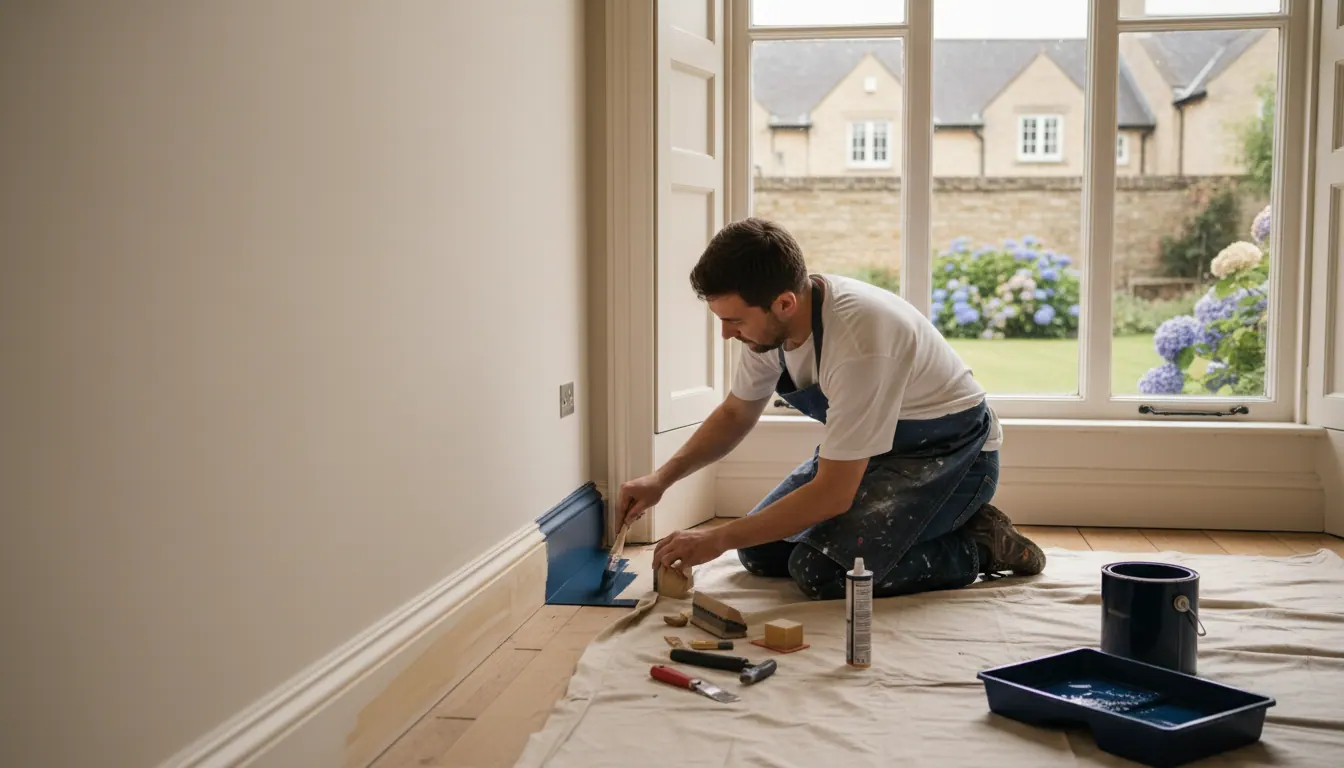
This is something I take seriously on every job. Skirting boards run along the floor edge, which means the carpet or hard flooring is directly in the line of fire. Sheets go down before I start, and I use proper masking along the floor edge when cutting in. The goal is that when I leave, there is nothing to clean up.
Louise Ellison, who had her woodwork glossed in the living room and hall, stairs and landing, put it well:
"Thank you for doing a great job of refreshing and glossing the woodwork in the living room and hall/stairs/landing. Work done in no time, with no splashes or damage to floor and carpets. Very efficient service, done by a thoroughly nice chap. More rooms to follow!"
That is exactly what I aim for on every job. No splashes, no sticky residue on the carpet edge, no masking tape left behind that pulls the paint off when you remove it. If you want to know more about how I approach protecting your home during decorating work, there is more detail in our article on protecting your home while we work.
Skirting Boards as Part of a Wider Woodwork Refresh
Skirting boards rarely exist in isolation. In most rooms, they sit alongside architraves around the doors, window boards, and sometimes picture rails or dado rails. When one is looking tired, the others usually are too.
The most satisfying jobs are when everything gets done together. Freshly glossed skirting boards next to a painted architrave that is still yellowing and chipped just highlights the contrast. I often suggest to homeowners in Coddington, Winthorpe and Claypole that we look at the whole room's woodwork at the same time, even if the walls themselves are fine.
A full woodwork refresh, without touching the walls, can completely change the feel of a room. It is one of those jobs that looks understated in photographs but makes a real difference to how a room feels day to day.
If your skirting board job is part of a broader lounge refresh, our article on painting your lounge covers what to expect when walls, ceiling and woodwork are all being tackled together.
Hall, Stairs and Landing Skirting: A Special Case
Hallways and stairwells are where skirting boards take the most punishment. Shoes, bags, pushchairs, furniture being moved in and out. The paint chips faster here than anywhere else in the house.
It also tends to be a more complicated area to work in. Staircase skirting follows the rake of the stairs, which means more fiddly cutting in and more awkward angles. Getting a clean, consistent finish on a staircase skirting board takes patience and the right tools.
In older properties around Newark and Coddington, the staircase skirting is often original timber, which is worth preserving properly rather than slapping a quick coat over. Good preparation here pays dividends for years.
What to Expect on the Day
I will sheet the floor before I start. Furniture near the skirting gets moved or protected. I work methodically around the room rather than rushing to get a coat on and leave.
Depending on the condition of the existing paint, there may be more sanding and filling than expected. I would rather take the time to do it properly than rush the preparation and have the finish look uneven. If I spot anything while I am working, such as a gap that needs caulking or a section of skirting that has pulled away from the wall, I will flag it before I start rather than paper over it.
When I am done, I tidy up, remove all the masking and sheets, and leave the room as I found it, minus the tired paintwork.
Frequently Asked Questions
How many coats of gloss do skirting boards need?
It depends on the condition of the existing surface. If the skirting has been properly prepared and primed where needed, two coats of topcoat usually give a good, even finish. If the existing paint is very dark, very uneven, or has been stripped back significantly, an extra coat may be needed. I assess this on the job rather than applying a fixed rule.
Can you paint skirting boards without removing them?
Yes, and in most cases that is exactly what I do. Removing skirting boards risks damaging the plaster behind them, and it is rarely necessary. Good masking and careful cutting in gives a clean result without pulling anything off the wall.
Do I need to leave the room while the paint dries?
For oil-based gloss, the smell is strong while it is wet, so good ventilation is important and it is worth keeping children and pets out of the room until the first coat has dried and the smell has cleared. Water-based finishes are much less intrusive. I will let you know which product I am using and what to expect.
Can you paint just the skirting boards, or is it a minimum full-room job?
Skirting boards alone are a perfectly reasonable standalone job. I do not have a minimum room size or a minimum scope. If the skirting boards in your hallway or living room in Coddington, Averham or Kelham need doing, that is enough reason to get in touch.
Ready to Get Your Skirting Boards Done?
If your skirting boards have been on the to-do list for a while, now is a good time to sort them out before winter sets in and the house feels shut in. I cover Coddington, Newark-on-Trent and all the surrounding villages including Balderton, Farndon, Fernwood, Winthorpe, Collingham, Hawton, Elston, Averham, Kelham, Sutton-on-Trent, Claypole and Long Bennington.
I am fully insured, I turn up when I say I will, and I leave your home tidy. If you would like to talk through what needs doing, call us on 07845 176906 and we can arrange to take a look.